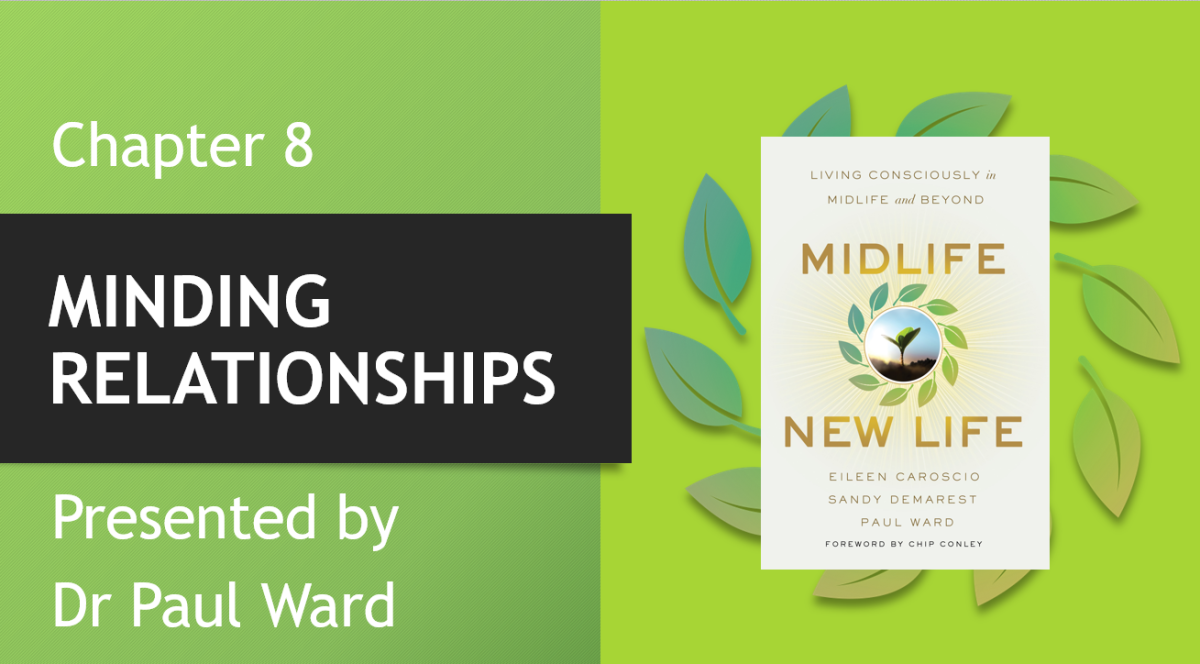
“Treasure your relationships, not your possessions” is wonderful advice from Anthony D’Angelo. It’s a reminder that at the end of the day, the richness of our lives is measured not by what we accumulate, but by who walks beside us. Minding Relationships is the eighth chapter of the book Midlife, New Life: Living Consciously in Midlife and Beyond. In this chapter of the book we explore our relationships with ourselves and others along a relationship continuum.
Relationship Continuum
Every relationship we have — every handshake, every shared meal, every late-night phone call — exists on a continuum. There’s a beginning, sometimes a spark. There’s emergence, where we circle each other and discover common ground. Then comes expansion and strengthening, where trust deepens and bonds solidify. Eventually, many relationships enter a steady maintenance mode. And sometimes, they decline or come to an end. But here’s the beautiful part: that continuum is never strictly linear. It can loop back, reignite, and surprise us. Relationships are living, breathing things — and we have the power to shape where they go.
Before we can truly connect with others, we must first connect with ourselves. Sean Perry, founder of the Senior Zone Radio Show, offered this wisdom: “It’s only till you begin to know who you are that those greater friendships and stronger relationships manifest.” Self-discovery isn’t selfish — it’s the soil from which every meaningful relationship grows. When we learn to accept ourselves with compassion and love, that energy radiates outward, mirrored back to us through the people we attract.
Then there’s intimacy — not as we typically define it, but as a radical act of courage. Others have reframed the word beautifully: “Into me see.” It means opening yourself up so that someone else can truly see inside you. It means choosing vulnerability over body armor. That’s where real connection lives — not in perfection, but in the willingness to be seen as you truly are.
Grief and Loss
Relationships also involve loss. People drift apart. Partners are lost. Hearts break and heal and break again. But even in grief, there is proof of love — because we only mourn what mattered. And even as some doors close, new ones open. New communities form. New friendships spark in unexpected places.
More and more people are living alone today. In the United States, around 26% of adults aged 65 and older live alone, a share that rises significantly with advancing age. For some, this is a matter of choice. For others, it is a result of the loss of a partner or another life-changing event.
Even in business, a space often dominated by competition and cold efficiency, there’s a growing movement to bring caring and compassion into the workplace. Love as a business strategy might sound radical — but what if it’s the most practical strategy of all? People don’t thrive where they feel invisible. They thrive where they feel seen, valued, and connected.
An Invitation
So here’s the invitation: Take a moment. Think about your relationships — the thriving ones, the fading ones, the ones you’ve been afraid to start. Where are these relationships on the relationship continuum? And what would happen if you chose, today, to show up with a little more vulnerability, a little more presence, a little more love? Because in the end, the relationships we nurture are the legacy we leave. Treasure them.
Watch this video to learn more about Minding Relationships: